
How Business Messaging Is Billed: SMS, WhatsApp, RCS, Voice
How SMS, WhatsApp, RCS and voice are billed: what each channel charges for, who sets the rate, and what to check on a messaging quote or invoice.
By OmniChannels.ai Editorial Team · Reviewed by BroadNet Messaging Solutions Team
Omnichannel
Short answer
Business messaging is billed by usage, channel by channel and country by country: SMS per segment, WhatsApp per delivered message by Meta's category, and RCS and voice by destination. On top of usage, a provider may charge for its platform, seats and add-ons, plus taxes, so the clearest bill shows each of these on its own line.
On this page
Key takeaways
- Almost every messaging bill mixes four kinds of charge: usage, third-party charges such as Meta's, the provider's own fees, and taxes.
- SMS is counted per segment, WhatsApp per delivered message by Meta's category, RCS per message or per 24-hour conversation depending on the agent, and voice by call and destination.
- The same message costs different amounts by country, length and alphabet (SMS), and category (WhatsApp); Meta changes WhatsApp rates only on 1 January, 1 April, 1 July or 1 October.
- Check a quote line by line: rates per country, how segments are counted, whether Meta's charges are marked up, minimums, rate validity, fallback billing and taxes.
- OmniChannels.ai quotes every part on its own line, with WhatsApp at Meta's rate and zero markup, no setup fee and no monthly minimum.
What are you actually paying for?
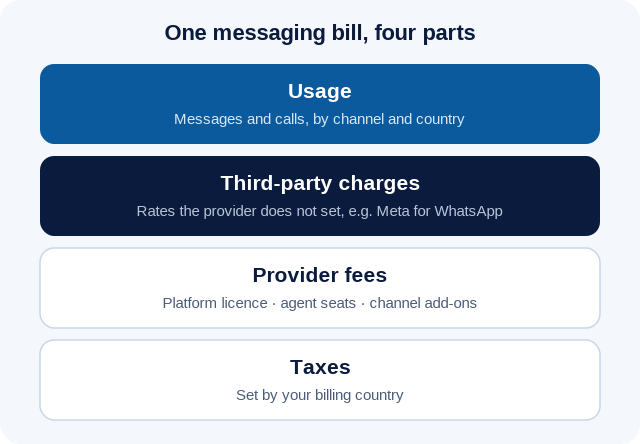
Almost every messaging bill mixes four kinds of charge:
- Usage: the messages and calls you send, priced by channel and destination country.
- Third-party charges: rates the provider does not set. For WhatsApp, Meta sets the rate by message category and recipient country (see our WhatsApp pricing page).
- Provider fees: a platform licence, a seat for each person answering customers, channel add-ons, and sometimes a setup fee.
- Taxes: set by your billing country.
A bill that blends these into one per-message price is hard to check. One that separates them can be checked line by line.
How is each channel billed?
| Channel | What is counted | Who sets the base rate | What moves the price |
|---|---|---|---|
| SMS | Each segment, by destination (our SMS rates are in USD per SMS segment before taxes) | Mobile operators set termination rates for their networks | Country, operator, message length and alphabet |
| Each delivered message, by category: marketing, utility, authentication or service | Meta | Category, recipient country, volume tiers for utility and authentication | |
| RCS | Under Google's RBM model: per message for non-conversational agents, or a fixed rate per 24-hour conversation once a user replies for conversational agents | Varies by carrier and country | Agent category, carrier, country, rich content or long text |
| Voice | Calls, by destination | Mobile operators | Destination |
For the detail of each channel, see how bulk SMS pricing works, WhatsApp Business API pricing in 2026 and how much RCS business messaging costs.
Why does the same message cost different amounts?
- Country: operators price their own networks, and Meta prices WhatsApp per recipient market. Our answer on why SMS prices differ by country explains the SMS side.
- Length and alphabet (SMS): a long message, or one in Arabic, uses more segments, and each segment is billed. Arabic uses more segments, so test your text in the SMS character counter before you budget.
- Category (WhatsApp): in Meta's rate card effective 1 October 2026, marketing costs more than utility or authentication in every market listed.
- Free allowances (WhatsApp):
- From 1 October 2026, each business phone number gets 1,000 free service messages a month.
- Replying to a customer who came from a Click-to-WhatsApp ad can open a free entry point window of 72 hours.
- What is no longer free (WhatsApp): utility templates sent inside the 24-hour customer service window were free from July 2025 to September 2026, and are charged at the utility rate from 1 October 2026.
- Timing: Meta changes WhatsApp rates only on 1 January, 1 April, 1 July or 1 October.
To see how category and country change a WhatsApp bill, try the WhatsApp pricing calculator.
Where does RCS fit in the budget?
Google describes RCS for Business as a way to "Measure engagement with read receipts and analytics, and build trust with a 'Verified' icon".
GSMA Intelligence estimates that 3.2 billion RCS messages were received worldwide each day at the beginning of 2026, with RCS for Business still a relatively small share (GSMA, 28 October 2026). Emanuel Kolta of GSMA Intelligence: "RCS has a real opportunity, but the clock is ticking."
GSMA notes that falling back to SMS can reach users whose phones are not RCS-capable yet. For your budget, ask how a fallback message is charged and include that volume in the estimate. For how RCS itself works, see RCS Business Messaging Explained.
What does an itemised quote show?
| Line | What it shows |
|---|---|
| Onboarding and sender registration | Any setup fee, and sender ID registration fees where a country charges them |
| Usage by market | SMS and RCS rates by destination, voice rates by call, for the countries you send to |
| Meta's WhatsApp charges | A separate third-party cost by message category and country |
| Provider fees | Platform licence, agent seats and channel add-ons |
| Billing and validity | How you pay, payment terms and how long the quoted rates remain valid |
| Taxes | On their own line |
How do you check a messaging quote? A checklist
| Ask | Why it matters |
|---|---|
| Is each channel priced per destination country? | A blended rate hides which markets drive the cost |
| Is SMS priced per segment, and how are long or Arabic messages counted? | Segments multiply the cost of one message |
| Are Meta's WhatsApp charges at Meta's rate, or marked up? | It is usually the largest WhatsApp line |
| Which fees belong to the provider: platform, seats, add-ons, setup? | So you can compare providers like for like |
| Are sender ID registration fees passed through at cost? | Some countries charge to register a sender name |
| Is there a monthly minimum? Is billing in advance or in arrears? | It decides cash flow and the risk of paying for unused volume |
| How long are quoted rates valid, and what happens when Meta or operators change theirs? | Rates move on dates you don't control |
| How are fallback messages billed? | One send can use two channels |
| Are taxes on their own line? | So totals before and after tax compare cleanly |
How OmniChannels.ai bills: one worked example
OmniChannels.ai, powered by BroadNet Technologies, prices on an itemised quote:
- Usage by channel and country, an optional platform licence, agent seats, channel add-ons, Meta charges and taxes, each on its own line.
- No setup fee and no monthly minimum; sender ID registration fees are passed through at cost. Usage is drawn from a prepaid wallet, and quotes are valid for 60 days.
- WhatsApp at Meta's rate, with zero markup.
- RCS and voice priced on request.
On our pricing page, Meta's charges appear "as a separate third-party cost by message category and country, with a reference to Meta's current rate card". Finance can check that line against Meta's own rate card. For a first estimate of your own volumes, use the cost estimator.
Instead of a trial, you get test access and a live demo: see the platform and ask about your own quote. Book a live demo.
Frequently asked questions
How is WhatsApp Business messaging billed?
Per delivered message, priced by Meta's category and the recipient's country under the rate card effective 1 October 2026. Provider fees come on top, unless the provider charges Meta's rate with no markup.
Are replies to customers free on WhatsApp?
Partly. From 1 October 2026, the first 1,000 service messages per business phone number each month are free, and later ones are charged.
Why does an Arabic SMS cost more?
The same message uses more billed segments in Arabic.
What is a prepaid wallet?
A balance you top up in advance, with usage drawn from it as you send.
Can I test before I commit?
Yes. OmniChannels.ai offers test access and a live demo.
Sources
Keep reading
More guidesOmnichannel
Channel Fallback Strategy: WhatsApp, RCS and SMS
How to design a channel fallback strategy across WhatsApp, RCS and SMS: fallback triggers, timeouts per message type, duplicate prevention, consent and cost.
12 min read
Omnichannel
Voice Broadcast Messages: Automated Calls Guide
Voice broadcasting explained: pre-recorded and text-to-speech calls, keypad replies, consent and calling-hour rules, answering machines, metrics and SMS fallback.
9 min read
Marketing
Government SMS and Citizen Messaging: A Practical Guide
How public agencies send citizen notifications by SMS, WhatsApp and voice: use cases, trusted sender IDs, anti-phishing practice and a procurement checklist.
9 min read